Kurdistan: On the wings of a dove
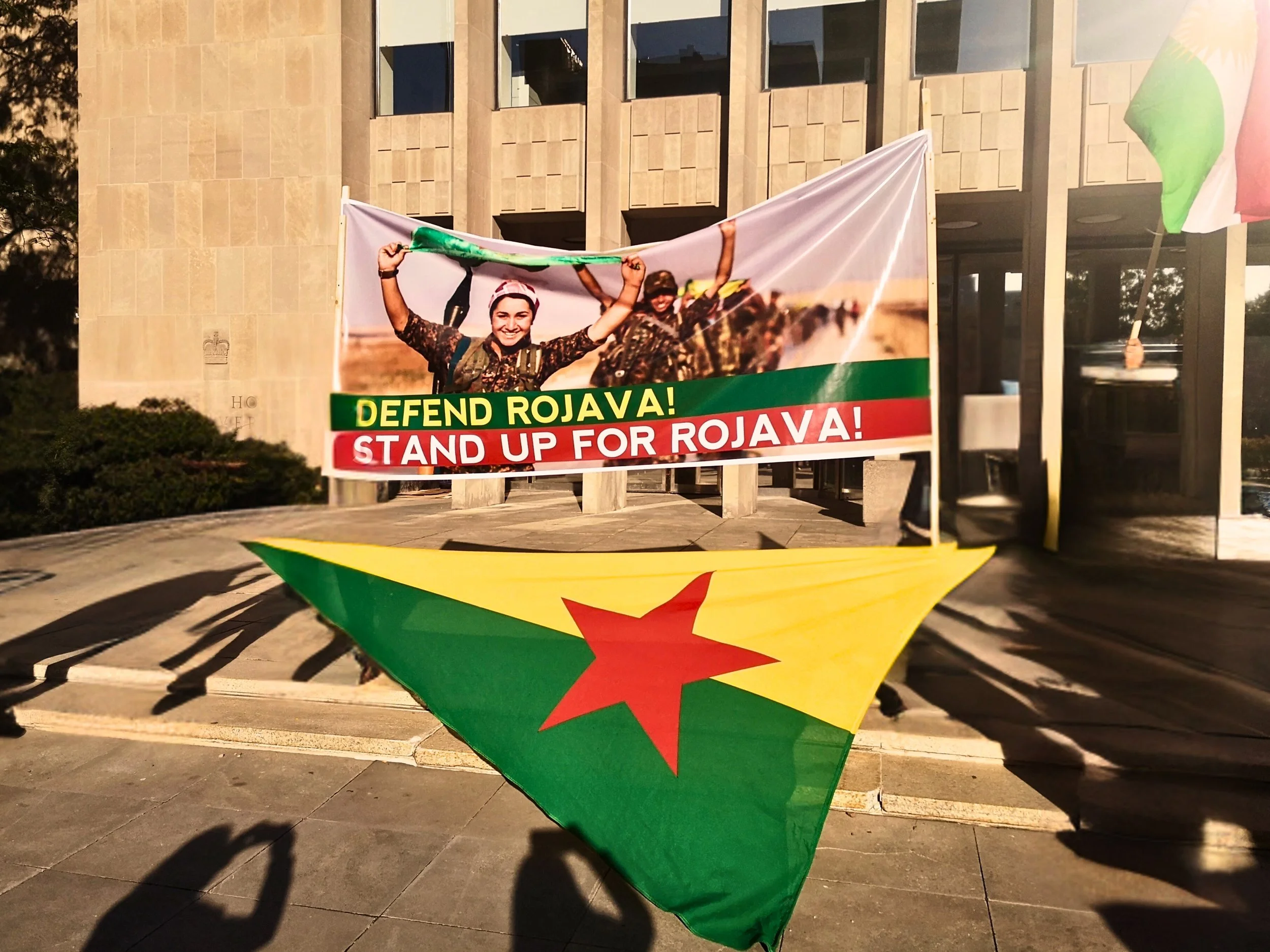
A protest in Toronto, Ontario, in solidarity with Rojava (Northern Syria), following the withdrawal of U.S. military forces that left the region exposed and vulnerable (Gardi, 2019).
A large sheet of poster board hangs from the blackboard with a list of common countries that most Canadian children of immigrants come from: Vietnam, Somalia, India, Afghanistan, amongst others.
We’re all sitting on the ground, criss-cross apple sauce, listening to our teacher call out our names one by one. Each one of my classmates stands up, says the country their parents are from, then sits back down on the carpet.
My cheeks are burning. I keep rereading the chart, and I can’t find Kurdistan on there, anywhere. If I keep searching and straining, it’ll magically appear, I thought to myself as I squinted as hard as I could.
“Nivar, it’s your turn. Where are your parents from?” My teacher gave me an encouraging glance.
I hesitated before finally saying, “My dad is from Iraq and my mom is from Iran.”
Not an exact lie, they technically are, I thought, trying to soothe myself from guilt at betraying my ancestors.
I was either seven or eight years old.
Geography class, eighth grade, I’m thirteen now.
The class activity is to write where our parents are from on Post-it notes; the teacher collects them and writes each country on the blackboard.
I excitedly wrote “Kurdistan.” This time, I get to say where I’m from.
As the teacher was writing out each country, he paused. “Who wrote this one? Kurdistan?”
“Me,” I said, raising my hand.
“That’s not a real country. I can’t put it on the blackboard.”
Everyone in the class started laughing.
“Why would you put a fake country?” one of my classmates exclaimed.
Tears stung the backs of my eyes.
I looked at the only other Kurd in the class pleading for him to back me up. He looked away, shamefully. He had written “Iraq” on the Post-it.
I explained that Kurdistan is a country, that it’s split into four parts, that I’m not from Iraq, that I’m Kurdish.
After much back and forth, the teacher finally gave in. Kurdistan was on the board!
These are two experiences that I had in public schools in Canada. We were taught to respect our hyphenated identities as a part of us as much as the Canadian identity is. We are hyphenated Canadians, and we always will be.
Being part of a diaspora community–being born and/or raised outside of your ethnicity’s country–does not mean you are separate from that country, community, or ethnicity.
“But, how come you’re so Kurdish? You were born in Canada. I’m surprised you care so much about what’s going on over there.” This is a phrase I’ve heard a lot, especially over the last few years post-pandemic, and I very much loathe it when people tell me this. As if my Kurdish identity can only exist if I was born in Kurdistan.
I’ve travelled to Kurdistan, I’ve lived in Kurdistan, my entire extended family–except for my siblings and my parents–lives in Kurdistan, and I have friends in Kurdistan. Of course I care about what’s going on over there. I will forever be infinitely attached to Kurdistan.
Growing up as a child of Kurdish immigrants means growing up with the weight of being the child of activists, Peshmerga (our resistance fighters turned army), survivors of genocide, displacement, and refugees.
Unfortunately, I have met many Kurds from the Kurdistan regions of Turkey and Iran who cannot speak Kurdish, even though they were born and raised in Kurdistan. The assimilationist policies of both Turkey and Iran forced many Kurds to forgo their Kurdish identity and forcibly adopt that of the oppressor.
Fortunately, we, diaspora Kurds, are safe to wave the flag of Kurdistan. We are safe to speak, express, cry, sing, grieve, and laugh in Kurdish. We are safe to open a fire, wear Kurdish clothes, and dance freely to celebrate Newroz. We are safe to sit around drinking strong black tea and munching on sunflower seeds while discussing Kurdish politics and human rights openly. We are safe to show up, be visible, and attend demonstrations and protests for Kurdistan without risking our safety.
When diaspora Kurds say we are from Kurdistan, we say it so proudly that non-Middle Easterners think Kurdistan is a sovereign nation-state.
Kurdish diaspora identity exists–not because of distance–but because of safety.
We aren’t on the frontlines physically defending Kurdistan; however, we are in classrooms, international parliaments, online, and in diaspora community spaces where we are able to educate and raise awareness on Kurds and Kurdistan.
The political role of diaspora Kurds cannot be understated. We have the privilege of being the transnational voice for Kurdistan, and what an absolute privilege it is to be able to use that voice.
While the Kurds in Kurdistan are the backbone and the foundation of the Kurdish movement, the Kurds in the diaspora are its wings–allowing the movement to fly freely worldwide.
Being Kurdish transcends borders.
Unity exists across all “four” parts of Kurdistan. We consider all of Kurdistan as one country. And when something happens in one part, everyone in the other three parts quickly mobilizes to help. Whatever happens in one part of Kurdistan, impacts and affects all the other parts.
As of writing this piece, the Kurds in Bakur (the Kurdistan Region of Turkey) and Bashur (the Kurdistan Region of Iraq) have completely disregarded the borders that have separated us for over a century to go help the Kurds in Rojava (Syria) against ISIS, the current Syrian Army, and Turkish-backed militias. Seeing thousands of Kurds bravely cross the borders in the snow and cold to go defend their brethren on the other side from ethnic cleansing was beyond moving.
Not only is there an invasion and ethnic cleansing happening in Rojava (Northern Syria) right now, but it’s also happening in the dead of winter. There are Kurdish families that have been displaced five times within the same week because the Syrian Army and their militias keep capturing and seizing new neighbourhoods, towns, villages, and cities.
Moreover, as a Kurd in the diaspora–especially in Canada–it’s difficult to protest en masse because of the winter. The snow, ice, and brutally cold weather make it difficult for protests to be accessible for everyone, especially for persons with disabilities.
Honestly, I don’t know how to function properly. I keep wearing my Kurdistan jersey, my hewrri (Kurdish scarf), my Kurdistan necklace, pins, and bracelets just to be visible.
I don’t know how to smile, laugh, or speak without Rojava’s annihilation, ethnic cleansing, and Arabization being in the back of my mind.
I don’t know how to hold this grief. I don’t know how to wrap my thoughts around any of this.
I feel so restless. I wish I could go stand shoulder to shoulder with our brave Kurdish women and men on the frontlines, fighting for our right to exist in a world that has been trying to erase us for over a century.
Thankfully, I must remind myself that I have my voice and my platform–it doesn’t matter how large or how small my outreach is–I am on the wings of the Kurdish movement, and it is my purpose to help it fly to the heavens.
Author’s Note:
As of publishing, events are unfolding rapidly in Rojava (Northern Syria). As a word of caution, please rely on multiple news outlets for full coverage on what is happening, including Kurdish sources. Many Kurdish outlets publish in English, Arabic, Turkish, Persian, and other languages.
Further Reading:
Support and Donations:
If you’d like to provide humanitarian support to Kurds affected in Rojava, you can donate directly to Heyva Sor a Kurdistanê (The Kurdistan Red Crescent), which is providing urgent medical and humanitarian aid on the ground: https://heyvasor.com/en/donation/
Even a small contribution helps provide immediate aid to displaced families, medical support, and essential supplies.